LAB#08 : AVL-Trees
Objectives:
1. Implementing the rotateLeft( )
method of AVLTree class.
2. Comparison of BSTs and AVL trees
when inserting data that is sorted.
3. Implementing a cross-reference generator
using an AVL tree.
1. Downloadables:
Download
lab08.zip.
After unzipping, the following files will be
added in the ics202 package:
AVLTree.java
The following files will be placed in a package
ics202.lab08:
AVLTreeTest.java
CrossReferenceBuilder.java
BinarySearchTreeTest2.java
MyAssociation.java
input.txt
2.
Task1
Study each of the
files: AVLTree.java, MyAssociation.java, input.txt.
The class
MyAssociation will be used in Task5 to create an AVL tree in which each node is
an association between a distinct word in a text-file and an object that stores
the frequency of that word in the text-file and all the line numbers in the
text-file in which that word appears.
3.
Task2
Implement the
method rotateLeft( ) in AVLTree.java.
Note: The
remaining tasks in this lab-work require the implementation of this method.
4.
Task3
(a) Using AVLTreeTest.java, create an AVL tree in which
the following keys are inserted in the given order:
8, 12, 14, 18, 20, 23
(b) Draw the resulting AVL tree. Verify
your result from the output of part (a).
(c) Using the program BinarySearchTreeTest2.java, create
a BST in which the keys in (a) are inserted in the same order.
(d) Draw the resulting BST. Verify your
result from the output of part (c).
(e) Repeat (a) and (c) by inserting keys in the
following order: 10, 5, 20, 3, 7, 15,
30. What do you notice?
(f) From the results in (a) and (c), which is a
better search-tree data structure, an AVL tree or an ordinary BST? Why?
5. Task4
(i) Verify all the insertion cases given in lecture#23
(“Insertion and Deletion in AVL-Trees”) from page#3 to page#7. For
each case,
insert the keys in the given order:
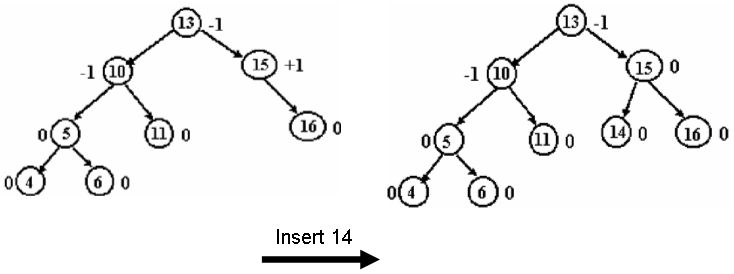
(a) Page#3: Insertion case 1: “Insertion
that does not cause an imbalance in the AVL tree”
13, 10, 15, 5, 11, 16, 4, 6, 14
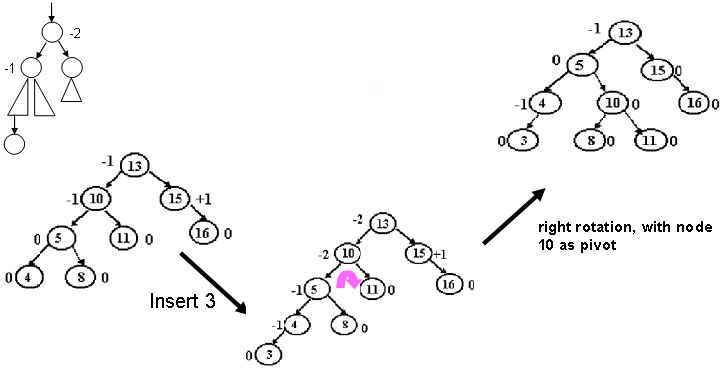
(b) Page#4: Insertion case 2a: “Insertion that
requires a single right rotation to rebalance the AVL tree”
13, 10, 15, 5, 11, 16, 4, 8, 3
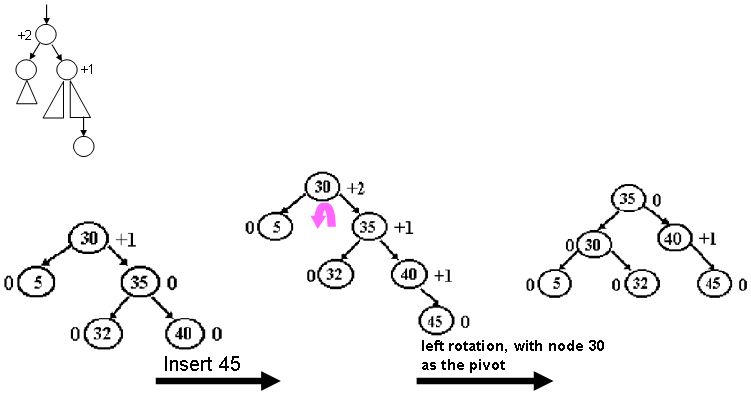
(c) Page#5: Insertion case 2b: “Insertion that requires
a single left rotation to rebalance the AVL tree”
30, 5, 35, 32, 40, 45
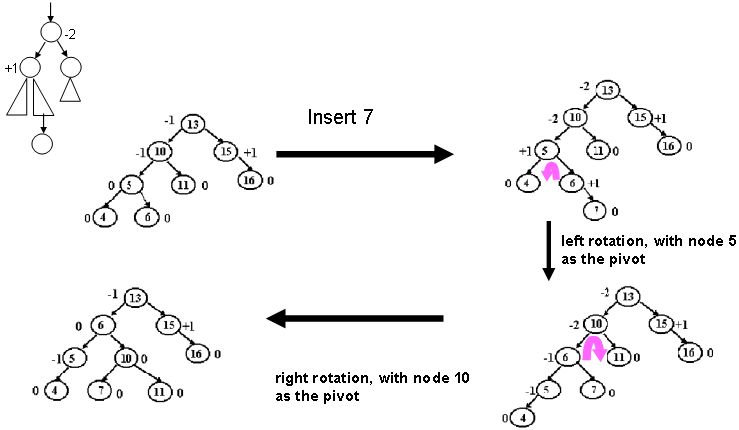
(d) Page#6: Insertion case 3a: “Insertion that
requires a double left-right rotation to rebalance the AVL tree”
13, 10, 15, 5, 11, 16, 4, 6, 7
(e) Page#7: Insertion case 3b: “Insertion that
requires a double right-left rotation to rebalance the AVL tree”
5, 2, 7, 1, 4, 6, 9, 3, 16, 15
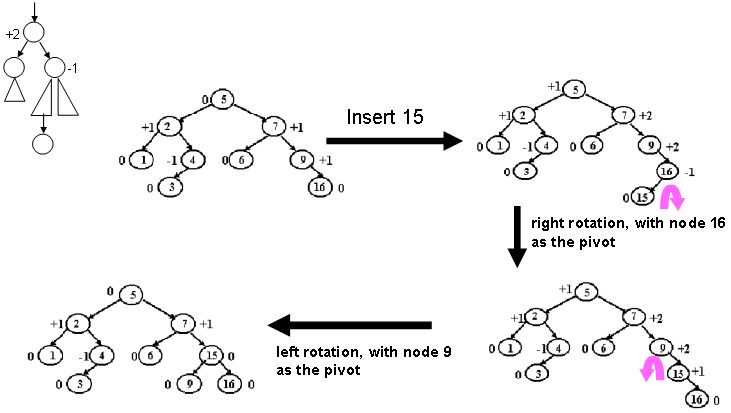
(ii) Verify that if you insert the following key sequence: 45, 50, 78,
40, 35, 43, 70 in an originally empty AVL-tree you will get the
following sequence of rotations: Single
Left, Single Right, Double Left-Right, Double Right-Left.
6. Task5
Comment the
println statements in rotateLeft( ), rotateRight( ) and balance( ) methods.
Complete the
choices in CrossReference.java as follows:
(a) Choice#1: As the program
reads a text-file it inserts MyAssociation objects in an AVL-tree. After
the text-file has been read, each association object contains a distinct word
from the text-file, together with the frequency of that word and all the
distinct line numbers in which it appears.
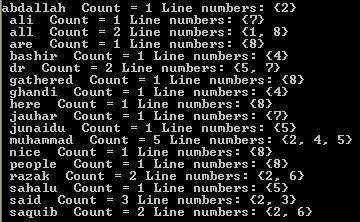
(b) Choice#2: The program
displays the created cross-reference (i.e., the AVL-tree that has been built in
(a)) in increasing order of keys. For example the given input.txt
results in the following output:
(c) Choice#3: The program
prompts for and reads a word to be searched in the AVL-tree created in (a). If
the word is found, the corresponding AVL-node is displayed; otherwise the
message: THE WORD IS NOT FOUND is displayed.