Ethical Hacking Short Course
|
“If you know the enemy and know yourself, you
need not fear the result of hundred battles” – Sun Tzu, Art of
War Course Title: Ethical Hacking: The new Approach to Security Who can attend: Software engineers, System administrators, Programmers, and anyone interested in the field of Security and Hacking. Requirements: Basic knowledge of programming, Basic knowledge of networking, Basic english. Duration: 4 days (Weekend) Dates*: September 11-14, 2013 Location: Information and Computer Science Department, KFUPM, Al-Dhahran, Saudi Arabia.
Instructor: Dr. Sami Zhioua Course Fees: 3000SAR (Special fees available for KFUPM students and staff) Registration: Department of Continuing Education, Building 54, Room 107. For Course details: zhioua@kfupm.edu.sa
* If you are a group and you are interested to take the course in a different date, you can contact the instructor for arrangement. |
 |

Ethical Hacking:
The explosive growth of the Internet has brought many good things: electronic
commerce, easy access to vast stores of reference material, collaborative
computing, e-mail, and new avenues for advertising and information distribution,
to name a few. As with most technological advances, there is also a dark side:
criminal hackers.
Governments, companies, and private citizens around the world are anxious to be
a part of this revolution, but they are afraid that some hacker will break into
their Web server and replace their logo with adult images, read their e-mail,
steal their credit card number from an on-line shopping site, or implant
software that will secretly transmit their organization’s secrets to the open
Internet.
In their search for a way to approach the problem, organizations came to realize
that one of the best ways to evaluate the intruder threat to their interests
would be to have independent computer security professionals attempt to break
into their computer systems. This scheme is similar to having independent
auditors come into an organization to verify its bookkeeping records. In the
case of computer security, these “tiger teams” or “ethical hackers” would
employ the same tools and techniques as the intruders, but they would neither
damage the target systems nor steal information. Instead, they would evaluate
the target systems’ security and report back to the owners with the
vulnerabilities they found and instructions for how to remedy them.

If a hacker wants to get inside your system, he/she will,
and there is nothing you can do about it
The only thing you can do is make it harder for him to get in.
Interesting facts about Hacking and Security:
- The majority of computer systems aren’t managed properly
- Most network and security administrators simply can’t keep up with the deluge of new vulnerabilities and attack methods
- Information systems grow more complex every year
- The law of averages works against security
- With the increased number of hackers and their expanding knowledge and the growing complexity of IT systems, eventually, all computer systems and applications will be hacked or compromised in some way.
- Hacking preys on weak security practices and undisclosed vulnerabilities.
- Firewalls, encryption, and passwords can create a false feeling of safety.
- These security mechanisms often focus on high-level vulnerabilities without affecting how the bad guys work.
- Attacking your own systems to discover vulnerabilities helps make them more secure.
- Ethical hacking is the only proven method of greatly hardening your systems from attacks.
- If you don’t identify weaknesses, it’s only a matter of time before the vulnerabilities are exploited.
- It’s one thing to know generally that your systems are under fire from hackers around the world and malicious users around the office;
- It’s another to understand and to see specific attacks against your systems that are possible.
- As hackers expand their knowledge, so should you.
- You must think like them and work like them to protect your systems from them.
- As an ethical hacker, you must know the activities that hackers carry out and how to stop their efforts.
- An ethical hacker possesses the skills, mindset, and tools of hacker but is also trustworthy.
- Ethical hacking involves the same tools, tricks, and techniques that hackers use, but with one major difference: Ethical hacking is performed with the victim’s permission.
- The intent of ethical hacking is to discover vulnerabilities from a malicious attacker’s viewpoint to better secure systems.
| Short Course Topics |
0. Background
Introduction to Networking
Introduction to Linux
Introduction to Python language
1. Initial Hacking steps
Scanning
Enumeration
Google Hacking
2. Hacking and infiltrating Operating Systems
Creating back-doors
Transferring and executing files in the victim
Opening sessions
3. Detecting Vulnerabilities
Vulnerability Scanners
Vulnerability databases
4. Using Exploitation tools
Writing exploits
Meta-Exploitation Tools
5. Password Cracking
Password cracking tools
Using dictionaries
Using rainbow tables
6. Network Hacking
Network Sniffing to observe traffic
ARP Poisoning attacks
Man-In-The-Middle attacks
Session Hijacking
7. Web Application Hacking
Top 10 Web Application Attacks
SQL Injection Attacks
XSS Scripting Attacks
Etc.
8. Hacking with Malwares and Rootkits
Different Types of malwares
Malware coding
Malware binders and packers
Bypassing Antivirus Tools
Social Engineering Toolkits
9. Other Topics
Software Cracking
Anonymous Group Denial of Service Attacks
Etc.
A Seminar on Hacking by Dr. Sami Zhioua (November 2011):

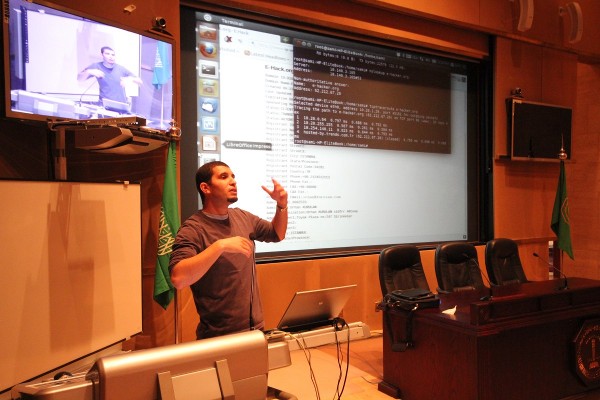


Sami Zhioua, April 2013